Rates on Hold, Risks in Motion

Global central banks held policy steady amid uneven growth signals, shaping risk appetite, capital
flows, and near-term conditions for South African markets.
SOUTH AFRICAN FINANCIAL AND ECONOMIC NEWS
The week’s key domestic developments ranged from a higher national minimum wage and renewed trade engagement with China, to expanded continental financing access, a leadership transition within the main opposition party, and survey data pointing to tentative stabilisation in business conditions.
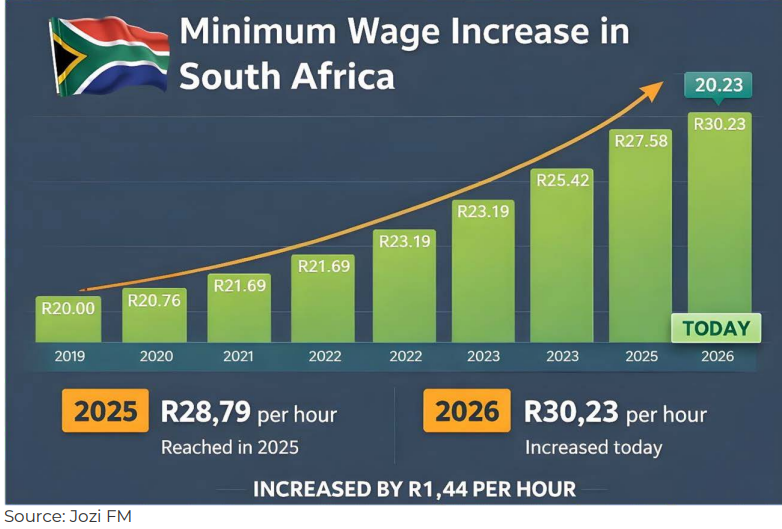
Minimum wage increase implemented from March
The South African Government confirmed that the national minimum wage will rise to R30.23 per hour from 1 March 2026, following its gazettement by the Department of Employment and Labour. The adjustment applies across key sectors, including farm and domestic work, and updates several sectoral determinations. The change reflects ongoing cost-of-living pressures and government efforts to ease income strain for low-paid workers. Employers are likely to absorb higher labour costs incrementally, while its broader impact on formal employment and consumer demand remains closely watched by economists.
Trade framework with China agreed
South Africa and China signed a framework economic partnership agreement in early February, laying the groundwork for an ‘early harvest’ trade deal targeted for finalisation by March 2026. The pact aims to expand market access for selected South African exports under preferential terms, while incorporating safeguards for local industries. The agreement highlights South Africa’s strategy to deepen economic ties with China amid global trade shifts and to support export diversification beyond traditional partners. Details on specific tariff lines and sectoral commitments are expected as negotiations proceed.
Afreximbank outlines financial package
South Africa formally became a full sovereign member of the African Export-Import Bank (Afreximbank), which announced it has prepared an initial $8 billion financing package for the country. The package is framed around supporting development-oriented funding, including trade facilitation and project finance across strategic sectors. This membership expands South Africa’s access to continental capital markets, potentially easing credit constraints for infrastructure and industrial projects. The actual deployment of funds and sectoral allocation will be key to judging its immediate economic significance.
Political leadership transition signalled in main opposition party
Democratic Alliance leader John Steenhuisen announced he will step down in April 2026, prompting a leadership contest within South Africa’s main opposition party. With the Democratic Alliance part of the Government of National Unity, the change has implications for party strategy and policy coherence in coalition governance. Market observers will assess whether the leadership shift supports consistent policy engagement with government on economic priorities or introduces heightened political competition that could influence investor confidence.
PMI data show stabilising business conditions
January’s Purchasing Managers’ Index (PMI) data painted a tentative picture of stabilisation in South African business activity. S&P Global’s PMI returned to a neutral 50.0 reading, up from 47.7 in December, indicating broadly unchanged private-sector conditions, with output and new orders stabilising. Meanwhile, the Absa manufacturing PMI improved to 48.7 from 40.5, though it remains below the 50 mark that separates contraction from expansion. The readings suggest easing contraction pressures, but a full sectoral recovery has not yet materialised.

KEY CURRENCY EXCHANGE MOVEMENTS OVER THE PAST 7DAYS
2 February – 6 February 2026
U.S. Dollar / South African Rand [USD/ZAR]
The rand strengthened from R16.09 on Monday’s open to R16.03 on Friday’s close (-0.37%).
The rand’s week was mainly shaped by global risk appetite and sharp swings in South Africa’s key export metals. After early-week turbulence that boosted the dollar and hit commodities, rebounds in gold and platinum later in the week supported the rand, alongside a rise in South Africa’s official reserves data that helped sentiment. A firmer dollar, tied to shifting Federal Reserve expectations after President Donald Trump nominated Kevin Warsh and to intermittent risk-off trading, likely capped the rand’s gains versus the greenback.

Movement: The USD/ZAR closed at R16.03 on Friday, 6 February 2026.
British Pound / South African Rand [GBP/ZAR]
The rand strengthened from R22.03 on Monday’s open to R21.79 on Friday’s close (-1.09%).
The rand’s gains versus sterling reflected both support for the rand from improved precious metals pricing and a midweek repricing of United Kingdom rate expectations that pressured the pound. The Bank of England held rates, but the unexpectedly close 5–4 vote and guidance that a cut may follow if inflation keeps cooling pushed markets towards earlier easing expectations, weighing on sterling. Political uncertainty in the United Kingdom added to the pound’s fragile tone into the end of the week.

Movement: The GBP/ZAR closed at R21.79 on Friday, 6 February 2026.
Euro / South African Rand [EUR/ZAR]
The rand strengthened from R19.11 on Monday’s open to R18.96 on Friday’s close (-0.78%).
The rand strengthened against the euro as a firmer tone in precious metals coincided with a softer euro backdrop around key Eurozone releases and the European Central Bank meeting. Euro area inflation eased in January and, while the ECB kept rates unchanged, the combination reinforced expectations of policy staying on hold for longer, limiting euro support. At the same time, broader dollar strength during parts of the week likely made it harder for the euro to outperform higher-beta currencies when commodity prices recovered.

Movement: The EUR/ZAR closed at R18.96 on Friday, 6 February 2026.
Swiss Franc / South African Rand [CHF/ZAR]
The rand strengthened from R20.87 on Monday’s open to R20.68 on Friday’s close [-0.91%].

Movement: The CHF/ZAR closed at R20.68 on Friday, 6 February 2026.
Japanese Yen / South African Rand [JPY/ZAR]
The rand strengthened from R0.1043 on Monday’s open to R0.1020 on Friday’s close [-2.21%].

Movement: The JPY/ZAR closed at R0.1020 on Friday, 6 February 2026.
WEEKLY JSE MOVERS OVER THE PAST 7 DAYS
Overall Market | FTSE/JSE All-Share Index [J203]

The FTSE/JSE All Share Index (J203) rose 0.01% this week, closing at 120,051.24 on Friday after opening at 120,045.73 on Monday.
What Moved the Market
An early-week shock in precious metals was offset by rotation into domestic shares and a late rebound, leaving the index broadly unchanged.
Precious metals shock: Gold and silver fell sharply early in the week, dragging mining shares lower.
Resources as swing factor: Day-to-day moves in gold and platinum-group metals drove most index volatility.
Rotation into SA-Inc: Banks and insurers attracted interest as investors rotated away from resources.
Global risk tone fragile: A tech-led wobble and firmer dollar kept broader risk appetite restrained.
Late-week repair: A bounce in metals on Friday helped claw back earlier losses.
The week was defined by offsetting forces. A sharp metals sell-off did the early damage, but rotation into domestic counters and a late-week rebound pulled the JSE back to near flat by Friday.
Top Gainers

The rally was supported by Accelerate’s announcement that it agreed to sell the Bosveld Bela Bela Shopping Centre for R88,000,000, with net expected cash proceeds of about R85,360,000 earmarked for debt reduction as part of its ongoing strategic repositioning and restructuring programme. This disposal reinforced the market’s turnaround narrative after the group previously guided that distributable earnings for the half-year were expected to swing back to a positive range, helped by the restructuring programme and an insurance settlement.

The move looked momentum-led, with no fresh price-sensitive SENS update during the week beyond the AGM notice that circulated shortly beforehand. Buying interest likely reflected a continued re-rating after Quantum’s audited full-year results showed a sharp earnings recovery and a final cash dividend, which helped anchor improving fundamentals. Sentiment across poultry-linked names also improved after Rainbow’s trading statement pointed to strong demand and lower feed costs from reduced commodity input costs, which may have provided a positive read-through for peers.
Top Losers

The decline was driven mainly by a sharp sector-wide selloff after a historic correction in precious metals, which triggered rapid de-risking across platinum-linked equities. While Implats guided to a large interim earnings uplift, the update underscored that the improvement was primarily price-driven, leaving sentiment sensitive to any pullback in spot pricing. The prior production update also pointed to cost pressure, with group unit costs expected to rise about 11%, which reduces margin resilience if metal prices soften. A favourable Zimbabwe court ruling for Zimplats offered support, but did not offset the broader risk-off move.

The share came under pressure after WeBuyCars disclosed that an associate of the two executive directors sold 18,723,178 shares in off-market transactions at an average price of R46.27 (about R866 million in value), a rare insider disposal since listing that likely added near-term supply and unsettled sentiment, despite management stating no further sales are intended in the near future. The move occurred against a backdrop of heightened consumer-regulatory scrutiny following the National Consumer Commission settlement (including a R2.5 million fine and refunds to affected customers), alongside market sensitivity about credibility and process risk after WeBuyCars replaced independent vehicle condition reporting with its in-house inspection subsidiary.
KEY INDUSTRY MOVEMENTS
At-a-Glance Takeaways
↓ Mining: Precious-metal weakness weighed on sentiment despite late support.
↑ Financials: Stable bond yields and rate-cut expectations supported the sector.
↑ Food Producers: Improved earnings outlooks and easing feed costs drove gains.
↑ Real Estate: Low bond yields increased yield appeal in listed property.
Mining | FTSE/JSE Mining Index [J177]
The FTSE/JSE Mining Index closed Friday at 157,456.80, down 1.79% from Monday’s open.
The sector was hit early as a sharp sell-off in gold and silver, linked to margin tightening and shifting United States rate expectations, weighed on local precious-metals counters and diversified miners. Sentiment steadied later in the week as gold and platinum rebounded, while company news such as Kumba Iron Ore’s upbeat full-year profit guidance provided some offset. Even so, the net decline points to continued caution towards resources as investors price in ongoing commodity volatility and policy-driven risk swings.
Financials | FTSE/JSE SA Financials Index [J580]
The FTSE/JSE SA Financials Index settled at 63,904.85 on Friday, up 1.78% from Monday’s open.
Financials were supported by a friendlier rates backdrop, as South African bond yields hovered near 8% and the interest-rate cycle was still seen as having room to ease. That environment tends to favour banks and insurers through valuation support, lower funding-cost expectations, and improved confidence in credit conditions, with sustained foreign appetite for local bonds also helping sentiment. The gain suggests investors leaned into domestic cyclicals while remaining sensitive to any reversal in bond yields, inflation surprises, or global risk appetite.
Agriculture | FTSE/JSE Food Producers Index [J357]
The FTSE/JSE Food Producers Index closed Friday at 10,063.81, up 3.79% from Monday’s open.
Company-specific catalysts helped, with RCL Foods issuing an initial trading statement and Rainbow Chicken pointing to a sharp improvement in interim earnings. Expectations of easing input costs also provided support, as lower maize prices should reduce feed costs for poultry producers over time and improve margin visibility into 2026. Overall, the rise reflects improving confidence in earnings normalisation, though the outlook still depends on consumer demand and the pace at which lower costs feed through.
Real Estate | FTSE/JSE All-Property Index [J803]
The FTSE/JSE All-Property Index (J803) closed Friday at 12,593.68, up 3.12% from Monday’s open.
Listed property benefited from bond yields holding near recent lows, lifting the relative appeal of dividend yields as markets weighed the timing of further rate cuts. Improving distributions and balance sheets supported sentiment, although the sector remains sensitive to higher funding costs, vacancy risks, and changes in sovereign risk pricing.
INTERNATIONAL NEWS AFFECTING SOUTH AFRICA
The week was shaped by central banks signalling caution on rates, renewed fiscal uncertainty in the US, tentative stabilisation in China’s manufacturing activity, and OPEC+ maintaining supply discipline, all influencing global risk sentiment and capital flows relevant to South African markets.
European Central Bank keeps rates unchanged
The European Central Bank held its three key policy rates steady (deposit facility 2.00%, main refinancing operations 2.15%, marginal lending facility 2.40%) and reiterated a data-dependent, meeting-by-meeting approach as it aims to keep inflation at 2% in the medium term. It said growth is underpinned by low unemployment, solid private sector balance sheets, and rising public spending on defence and infrastructure, but flagged uncertainty from trade policy and geopolitical tensions. A steadier euro rate outlook can help stabilise global yields, supporting appetite for South African bonds and equities.

United States shutdown rattles markets and delays key data
A partial United States government shutdown disrupted federal operations and led the Bureau of Labor Statistics to delay the January employment report, removing a major near-term input for interest rate expectations. President Donald Trump then signed a $1.2 trillion spending deal that restored funding for defence, healthcare, labour, education, housing, and other agencies, while extending Homeland Security funding only until 13 February as immigration-related negotiations continue. Heightened fiscal uncertainty can push investors towards safer assets, which often weighs on South African equities and bonds.
China factory survey points to firmer external demand
A private survey showed China’s manufacturing activity expanded slightly faster in January, with the RatingDog China General Manufacturing Purchasing Managers’ Index rising to 50.3 from 50.1 as export orders rebounded and output growth improved, lifting hiring to its strongest level in three months. The reading contrasted with an official survey that suggested softer activity, underscoring uneven demand conditions. Any improvement in Chinese industrial momentum can support South African export volumes and earnings expectations, shaping sentiment towards local cyclicals.

Bank of England signals a possible cut ahead
The Bank of England held Bank Rate at 3.75% after a 5-to-4 vote, with four members backing a 0.25 percentage point cut. The committee expects inflation to fall back towards the 2% target from April as energy price effects fade and indicated that Bank Rate is likely to be reduced further, though the timing depends on incoming data and the balance of risks. Softer UK rate expectations can ease global funding conditions, supporting appetite for higher-yielding South African assets.

OPEC+ keeps output steady and pushes compliance cuts
OPEC said it received updated compensation plans from Iraq, the United Arab Emirates, Kazakhstan, and Oman to offset production above their targets, with cuts scheduled through June. The update followed an OPEC+ decision to keep output unchanged for March, extending its pause on planned increases amid seasonally weaker consumption. Greater supply discipline can move crude prices and inflation expectations. For South Africa, higher oil prices tend to worsen the trade balance and lift fuel-driven inflation risks, complicating the local rate outlook.
SOURCES INCLUDED BUT NOT LIMITED TO

This report is published by Everest Wealth for general information and educational purposes only and does not constitute financial advice as defined by the Financial Advisory and Intermediary Services Act, 2002 (FAIS Act). The content is based on market research conducted around the reporting date. Figures and insights may change due to market conditions. Please note that past performance is not indicative of future results. Please consult with a licensed Financial Advisor to determine if such investments are appropriate for your individual circumstances.
Everest Wealth Management (Pty) Ltd is an authorised Financial Services Provider (FSP 795) and a registered credit provider (NCRCP 21504).